
Despite its name, most people who develop tennis elbow have never picked up a racquet, experts estimate more than 9 in 10 cases have nothing to do with the sport at all. From desk workers gripping a mouse all day to parents carrying toddlers, tradesmen using power tools, and home cooks chopping and stirring for hours, this nagging outer-elbow pain shows up wherever the same wrist and forearm motion repeats itself day after day. If you’ve noticed a sharp twinge every time you lift a kettle or shake someone’s hand, it’s worth understanding exactly what’s happening in your arm and what actually works to fix it.

As explained by the NHS, tennis elbow is a common cause of elbow pain caused by overusing the muscles and tendons around the elbow joint, and it usually improves with rest and the right treatment.
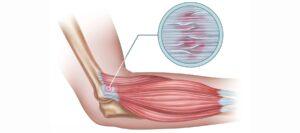
Tennis elbow, medically known as lateral epicondylitis, is an overuse injury affecting the tendon that attaches your forearm’s extensor muscles to a bony bump on the outside of your elbow (the lateral epicondyle). “Epicondylitis” technically means inflammation of that tendon and “lateral” simply refers to the outer side of your arm when your palm faces forward. This tendon is at work every time you extend your wrist or grip something firmly, from typing to twisting a screwdriver.
Unlike an acute injury from a single traumatic movement, tennis elbow usually develops gradually though a sudden, forceful injury can occasionally trigger it too. Repeated micro-loading on the extensor tendon, without adequate recovery time between activities, causes small collagen fibre tears to accumulate faster than the body can repair them. Over weeks or months, this leads to degenerative changes in the tendon rather than purely active inflammation which is why tennis elbow often lingers far longer than a typical sprain.

Using hand tools, typing, or carrying heavy bags with a bent wrist.

Off-centre ball contact or an overly tight grip transferring shock straight into the forearm.

A weekend of intense DIY, gardening, or gym work after a long period of inactivity.

Reduced tendon elasticity, most common between ages 35 and 55.
Catching tennis elbow early makes recovery significantly faster. Watch for:
While anyone can develop tennis elbow, you’re at higher risk if you:
Diagnosis usually starts with a physical exam a doctor or physiotherapist will check your range of motion, grip strength, and reproduce your pain with specific resisted-wrist movements, while asking when symptoms started and what makes them better or worse.
Most cases don’t require imaging, but if symptoms are unclear or not improving, a doctor or physiotherapist may order an X-ray, ultrasound, MRI, or EMG to rule out other causes and check the extent of tendon damage.
In the early stages, rest, ice, compression, and elevation (RICE) alongside over-the-counter pain relievers or anti-inflammatories can help settle acute discomfort. This buys time for more targeted rehab to begin but on its own, it rarely resolves the underlying tendon problem.
The cornerstone of modern tennis elbow treatment is eccentric strengthening, slow, controlled lengthening contractions of the wrist extensor muscles. This approach stimulates collagen remodelling within the tendon, rebuilding its capacity to handle load without triggering further micro-tears.
Hands-on techniques, including deep friction massage and joint mobilisation of the elbow and wrist, help break down restrictive scar tissue, improve local blood flow, and restore normal movement patterns that may have been compensating for the pain.
For persistent, deep-seated tightness in the forearm extensor muscles that hands-on therapy alone cannot fully release, dry needling targets active trigger points directly. This technique triggers a local twitch response that resets muscle tension, improves circulation, and accelerates the tendon’s healing environment.
For chronic cases that haven’t responded to conservative care, shockwave therapy uses focused acoustic waves to stimulate blood flow, break down calcified deposits within the tendon, and kick-start the body’s natural repair process.
If pain persists despite weeks of physiotherapy, a doctor may consider additional medical options, including a corticosteroid injection for short-term relief, platelet-rich plasma (PRP) injections to stimulate healing, or in select cases a minimally invasive medical tenotomy performed under ultrasound guidance. Surgery is rarely needed and is generally reserved for severe, persistent cases that haven’t responded to months of conservative treatment.
Tennis elbow typically takes around six months to heal, though some cases take up to 18 months depending on how severe the tendon damage is, what caused it, and which treatments are used. The good news: the vast majority of people make a full recovery and return to all their usual activities including sport once the tendon has properly healed. Continuing to push through pain before the tendon heals raises the risk of a tendon rupture, so it’s worth respecting your recovery timeline rather than rushing back too soon.
Don’t wait it out if you notice any of the following:
If you’ve been searching for reliable tennis elbow treatment, tennis elbow physiotherapy near me, or a trusted physiotherapy center in Puchong, Wai Physio’s clinical team combines manual therapy, dry needling, and progressive rehab programs to get you back to pain-free gripping, lifting, and playing.
Don’t let tennis elbow quietly limit your daily activities or sideline you from the sports you love. Address the root cause with an evidence-based recovery plan built around your body and your goals.
Schedule your elbow pain assessment with Wai Physio today and get back to a strong, pain-free grip!