

Children's Posture: Scoliosis & Knock Knees — What Should Parents Look For?

Post-Holiday Back-to-School Posture: Screening Children for Scoliosis & Knock Knees 

Differentiating Habitual Slouching from Structural Conditions

When children return to school, they spend long hours sitting in classrooms, studying, using tablets, or doing homework. Parents frequently notice rounded shoulders, uneven shoulder heights, or knees turning inward, and worry: “Does poor posture mean my child has scoliosis?”

Not necessarily. Understanding the difference between habitual posture, normal growth variations, and conditions requiring clinical assessment is essential for parents.

Understanding Lower Limb Alignment: Knock Knees (Genu Valgum) 

Common Parental Concerns Explained

1. Can Poor Posture Cause Scoliosis?

No. Poor sitting posture or carrying a heavy school bag does not cause Adolescent Idiopathic Scoliosis (AIS). However, prolonged static sitting and heavy backpacks can cause muscle fatigue and temporary localized back discomfort.

2. What Are Knock Knees? 
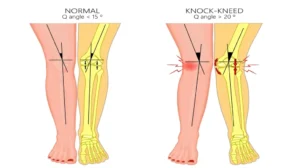
Knock knees occur when the knees touch or hover close together while the ankles remain separated when standing straight.
  • Normal Development: Some degree of knock-knee positioning is a completely normal part of childhood growth (typically peaking between ages 3 and 5).
  • When to Assess: If knock knees are pronounced, persist past age 7, cause pain, affect running style, or appear noticeably asymmetrical on one side.

What Is Scoliosis & What Should Parents Look For?

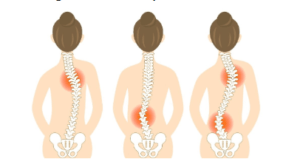
Scoliosis is a three-dimensional condition involving curvature and rotation of the spine. It often emerges during growth spurts in children and adolescents. Importantly, early-stage scoliosis is frequently painless.

Home Visual Checklist for Parents:

Observe your child standing naturally from behind:

  • [ ] Are the shoulder heights uneven?
  • [ ] Does one shoulder blade protrude more prominently than the other?
  • [ ] Is there an uneven waistline or hip height difference?
  • [ ] Does the body lean visibly to one side when standing?
  • [ ] Is there a rib hump visible when bending forward at the waist (Adam’s Forward Bend Test)?

These visual signs do not guarantee a scoliosis diagnosis, but they indicate that a professional screening by a physiotherapist or medical doctor is recommended.

Practical Guidance for Parents

  • Encourage Ergonomic Variety: Good posture does not mean forcing a child to sit perfectly rigid all day. Encourage regular movement breaks every 30–45 minutes.
  • Promote Active Play: Swimming, cycling, gymnastics, running, and ball games help build natural trunk strength and motor coordination.
  • Role of Physiotherapy: A physiotherapist can evaluate lower-limb alignment, spinal flexibility, and posture. If structural scoliosis is identified, targeted scoliosis-specific exercises or specialist referral can be arranged promptly.

Prevention & Ergonomic Adjustments for Students and Kids 

Establishing good ergonomics and posture habits early helps protect your child’s developing framework during long study sessions: 

  1. Optimize the Study Station 
  • Rule of 90 Degrees: Ensure your child sits with their feet flat on the floor, with hips and knees bent at a comfortable 90-degree angle. 
  • Eye-Level Screen & Books: Place study materials and tablets directly at eye level to prevent forward head posture (“tech neck”) and upper back strain. 
  • Break Up Sitting Time: Encourage children to stand up, stretch, and walk around every 30 to 45 minutes to reduce continuous compressive load on lumbar discs. 
  1. Core & Back Strengthening Exercises
  • Planks: Builds deep core stability to support the anterior spine (Hold for 20–30 seconds, 3 sets). 
  • Superman Holds: Strengthens the spinal erectors and gluteal muscles (Hold for 5 seconds, 10 reps). 
  • Thoracic Extension Stretches: Gently opens up the chest and reverses slouched posture caused by heavy backpacks. 

Non-Surgical Clinical Interventions & Family Care 

Targeted Scoliosis Physiotherapy 

When caught early, specialized scoliosis physiotherapy provides non-surgical solutions to manage spinal curves. We utilize targeted posture retraining, three-dimensional breathing techniques, and asymmetric core stabilization exercises to strengthen muscles on the convex side of the curve. This helps stabilize spinal alignment, improve symmetry, and reduce the need for rigid back bracing. 

Multi-Generational Family Care at Wai Physio 

A qualified physical therapist at an established physiotherapy center does more than care for growing children. Clinical practices offer holistic, multi-generational family care under one roof from managing pediatric posture and adolescent sports injuries to providing specialized vertigo physiotherapy to restore balance and prevent falls in elderly grandparents. 

Finding Regional Care for Your Family 

Don’t let heavy backpacks and poor sitting habits compromise your child’s spinal development this school term. Give them the best foundation for healthy growth with a professional assessment at trusted physiotherapy center in Puchong. 

Book a pediatric posture checkup at Wai Physio today and protect your child’s spine for the future! 

Related Posts